Raw concrete arts buildings run along the river past the Royal Festival Hall and the Hayward Gallery, and County Hall's stone facade played the Old Bailey on screen.
What South Bank looks like
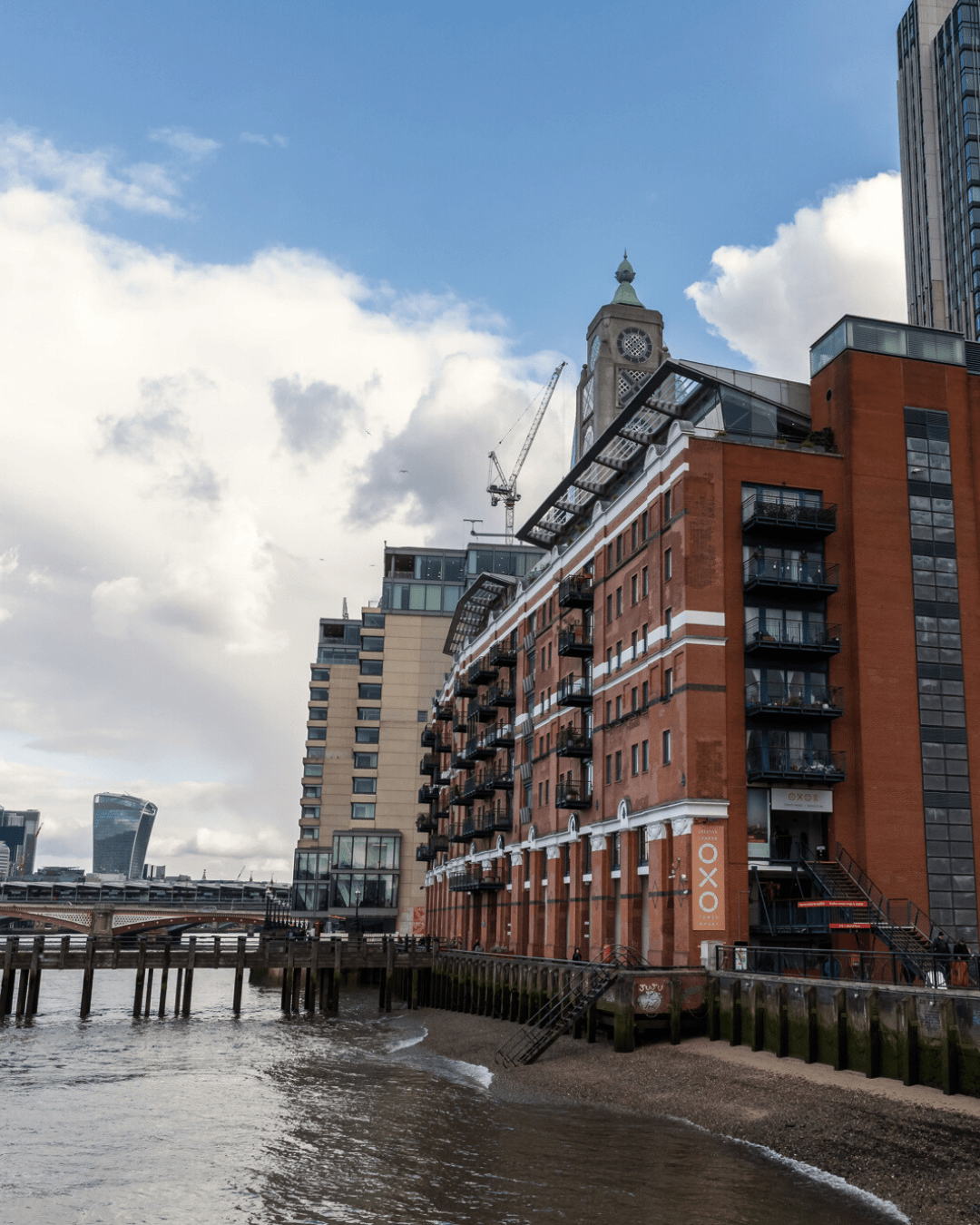
A paved riverside walk runs under plane trees from to the Oxo Tower, with the Thames on one side and a run of raw concrete arts buildings on the other. Elevated walkways link the buildings above street level, stepping down toward the water in board marked concrete terraces.
The 's concrete dates from 1951, its long glass fronted facade under a shallow arched roof, the venue's name lettered across the front in tall capitals. The , Queen Elizabeth Hall and date from the 1960s and 1970s, their board marked concrete cast in wood formwork that leaves the grain visible in the finished surface. Pyramid shaped rooflights sit on the Hayward Gallery's roof terrace, and the National Theatre's own terraces step out toward the river in overlapping blocks.
Beneath Queen Elizabeth Hall, a concrete undercroft is covered in decades of spray paint across its walls, ramps and banked ledges. Skateboarders use the space daily, weaving around the concrete pillars that hold the hall above them.
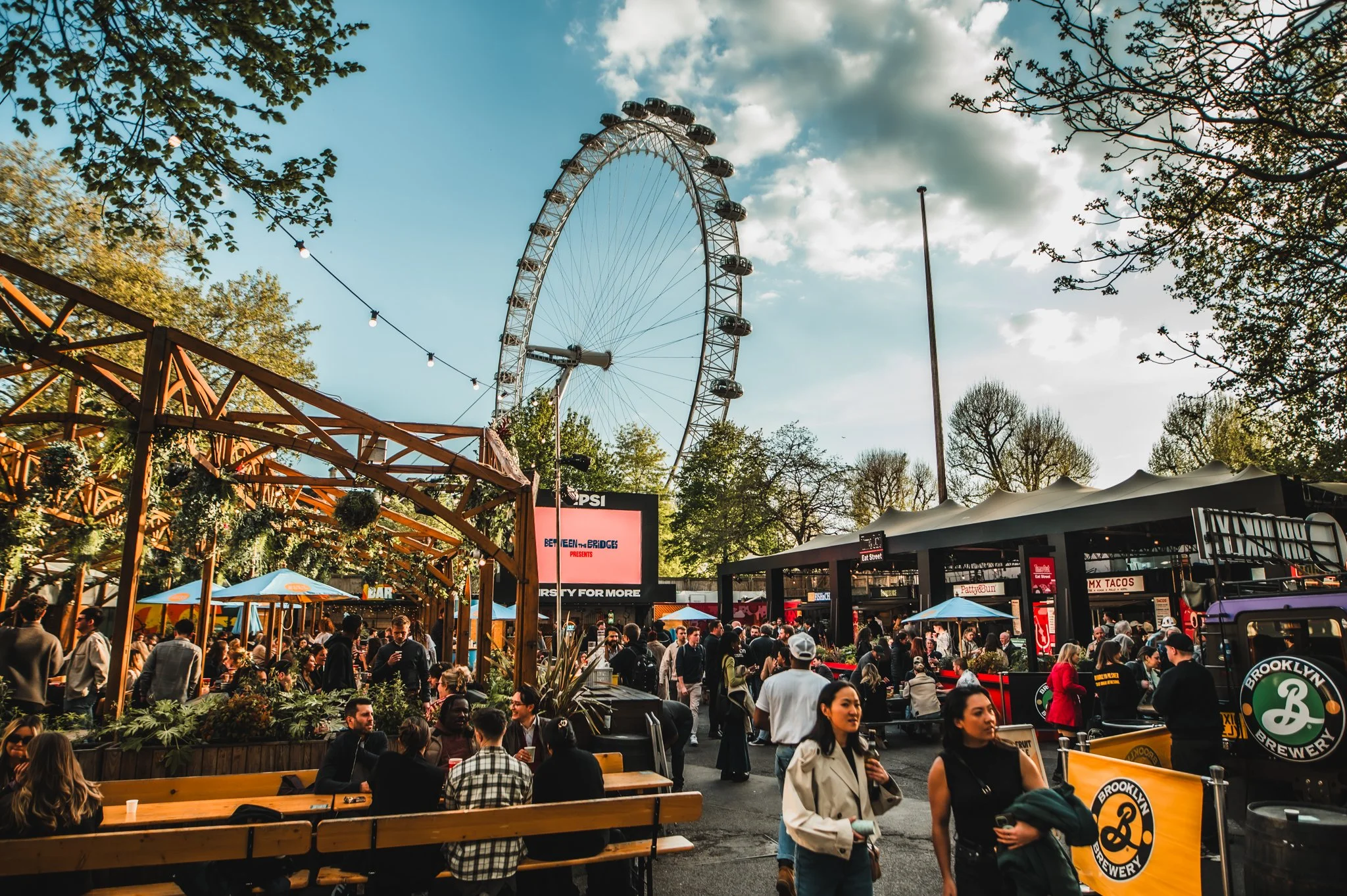
County Hall stands at the western end in pale Portland stone, its long curved facade and columned entrance dating from 1909, next to the raw concrete of its neighbours. The turns beside , an open lawn of grass and trees between the wheel and the river walkway.
Shot in South Bank
The Royal Festival Hall has drawn cameras since it opened. Southbank Centre's other buildings keep drawing them too, mostly playing themselves. County Hall, at the other end of the walk, has played itself far less often. It has stood in for a Virginia intelligence agency, an Old Bailey courtroom and a New York apartment entrance instead.
The Professionals, 1978
Royal Festival Hall
The ITV series The Professionals staged the kidnapping of a visiting Israeli minister outside the Royal Festival Hall in its 1978 episode First Night. The getaway went by hovercraft from Festival Pier, on the Thames.
Requiem, 2018
The BBC One and Netflix series Requiem opens with cellist Matilda about to perform inside the Royal Festival Hall. Lydia Wilson plays Matilda in the series.
Killing Eve, 2020
Hayward Gallery
The BBC America series Killing Eve filmed a walk between MI6's Carolyn Martens and an agent named Audrey for its third series, from the doors of Queen Elizabeth Hall to the doors of the Hayward Gallery. Fiona Shaw plays Martens.
Thunderbirds, 2004
Jubilee Gardens
Thunderbird 2 makes a deliberately rough emergency landing at Jubilee Gardens in the 2004 film. The London Eye is right beside it.
Fantastic Four: Rise of the Silver Surfer, 2007
The sequence in which the Silver Surfer threatens to pull the London Eye into the Thames was filmed at Jubilee Gardens, on Belvedere Road. The wheel plays itself in the scene, with Jubilee Gardens as the vantage point below it.
Scandal, 1989
County Hall
Played the Old Bailey courthouse, City of London, London, 1963
The 1989 film Scandal used County Hall's riverside facade as the exterior of the Old Bailey for Stephen Ward's 1963 trial. The courtroom scenes inside were filmed elsewhere, at Shire Hall in Nottingham.
Mission: Impossible, 1996
Played CIA headquarters, Langley, Virginia, 1996
County Hall's interior stood in for CIA headquarters in Langley, Virginia. Only the interior was used, and the CIA building's real exterior in Virginia appears in the same 1996 sequence.
Kick-Ass, 2010
Played a crime boss's high rise apartment entrance, New York City, 2010
In Kick-Ass, the Belvedere Road entrance of County Hall became the doorway to crime boss Frank D'Amico's high rise apartment building. No such tower stands behind it, only the entrance itself was used.
What South Bank can double for
Barbican Centre in City of London, London, United Kingdom
The Barbican Centre in the City of London uses the same board marked concrete and elevated walkways that link Southbank Centre's own buildings, completed in 1982 by the same generation of London Brutalist architects. Both complexes route pedestrians above street level past raw grey concrete terraces, so a walkway shot from either could pass for the other. The Barbican's walkways run past residential towers and a lake rather than a river, so keeping the Thames and its skyline out of frame is what holds the match. Try searching board marked concrete walkways now.
University of East Anglia in Norwich, Norfolk, United Kingdom
Denys Lasdun designed both the National Theatre and the University of East Anglia's Norfolk and Suffolk Terraces, whose stepped concrete blocks and elevated walkways date from the same mid 1960s to 1970s span as the South Bank's own Brutalist buildings. The repeated ziggurat profile and board finished concrete give it the same family resemblance on camera. UEA's terraces step down toward a lake inside a campus rather than a river in the middle of a city, so keeping any wide skyline out of frame is what holds the illusion. Try searching stepped concrete terraces now.
City Hall Plaza in Boston, Massachusetts
Boston City Hall Plaza is a multi level Brutalist civic plaza from 1968, its concrete terraces stepping down in a cascade close to Southbank Centre's own decks. The scale and the raw concrete massing are close enough to double for a wide plaza shot. Boston's plaza is paved in red brick rather than grey concrete, so a tight, low frame on the steps and walls holds the match better than a wide one. Try searching concrete plaza terraces now.