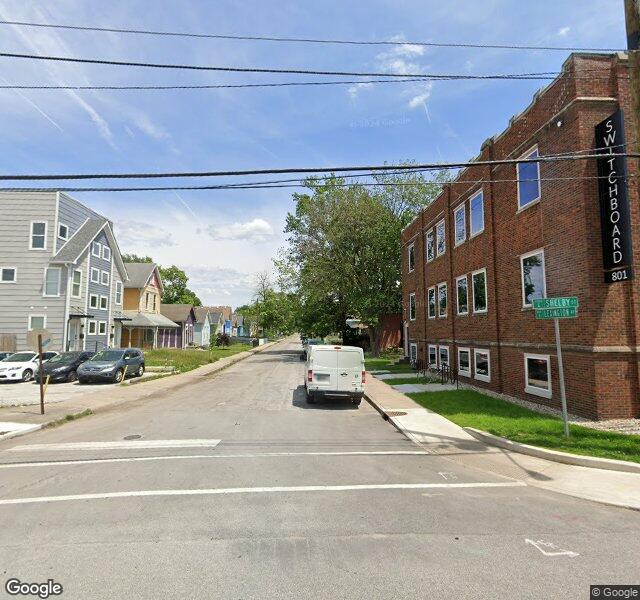
A diagonal avenue meets the city grid at a fountain, with a restored 1928 theatre and brick shopfronts on every corner.
What Fountain Square looks like
Virginia Avenue cuts across the city grid at an angle, meeting Prospect Street and Shelby Street at a crossroads with a bronze and stone fountain at its center. Two and three storey brick buildings front all four approaches, their ground floors glass storefronts and their upper floors flats, brick cornices and pressed metal trim still on most of the corners.
The faces the crossroads at Shelby and Prospect, five storeys of brown brick and terra cotta trim under a marquee strung with yellow and orange bulbs. A mosaic tile floor spells out FOUNTAIN SQUARE THEATRE at its entrance, and a rooftop Coca-Cola sign and a red neon marquee for its bowling alley and restaurant still light up after dark.
Toward Woodlawn Avenue, Virginia Avenue keeps its storefront glass and painted signs under two and three storey brick blocks. A rooftop nearby reads YOU ARE BEAUTIFUL in white block letters. A few blocks over, a mid-century filling station holds the rounded blue and white tiled corner, its service bay doors still built into the wall. Newer construction sits between the older blocks too, a taller red panel and grey brick building with retail under apartments.
East on Prospect Street, wood siding meets brick at State Street, where a grocery and taqueria fills a pink trimmed clapboard corner beside a two storey brick building with F&AM cut into its parapet. At the neighborhood's western edge, a small park called sets a row of blue stadium seats on a gravel overlook above the interstate, where Virginia Avenue crosses it.
Shot in Fountain Square
HGTV's Good Bones has filmed the neighborhood's house flips in Fountain Square since the series began here in 2016. Going All the Way, the 1997 film adapted from Dan Wakefield's Indianapolis novel, used the same neighborhood as a location.
Going All the Way, 1997
Going All the Way used Fountain Square as a real Indianapolis location, adapting Dan Wakefield's semi-autobiographical novel. The production does not name a specific building here. Street View
Vine Street's two storey brick and cast iron storefronts share Fountain Square's scale and streetcar-era retail rhythm, the same storefront glass and cornice line repeating block after block. Over-the-Rhine's buildings run taller and closer together in a wide shot, and its cast iron fronts read differently under a long lens than Fountain Square's plain brick. Try searching brick storefronts cast iron now.
Westport's brick commercial blocks keep a similar two to three storey scale, their original shopfronts now bars and restaurants the same way Fountain Square's have filled in. Westport's blocks run straight rather than meeting at an angle, so a wide shot showing the street pattern would give it away. Try searching brick commercial blocks bars now.