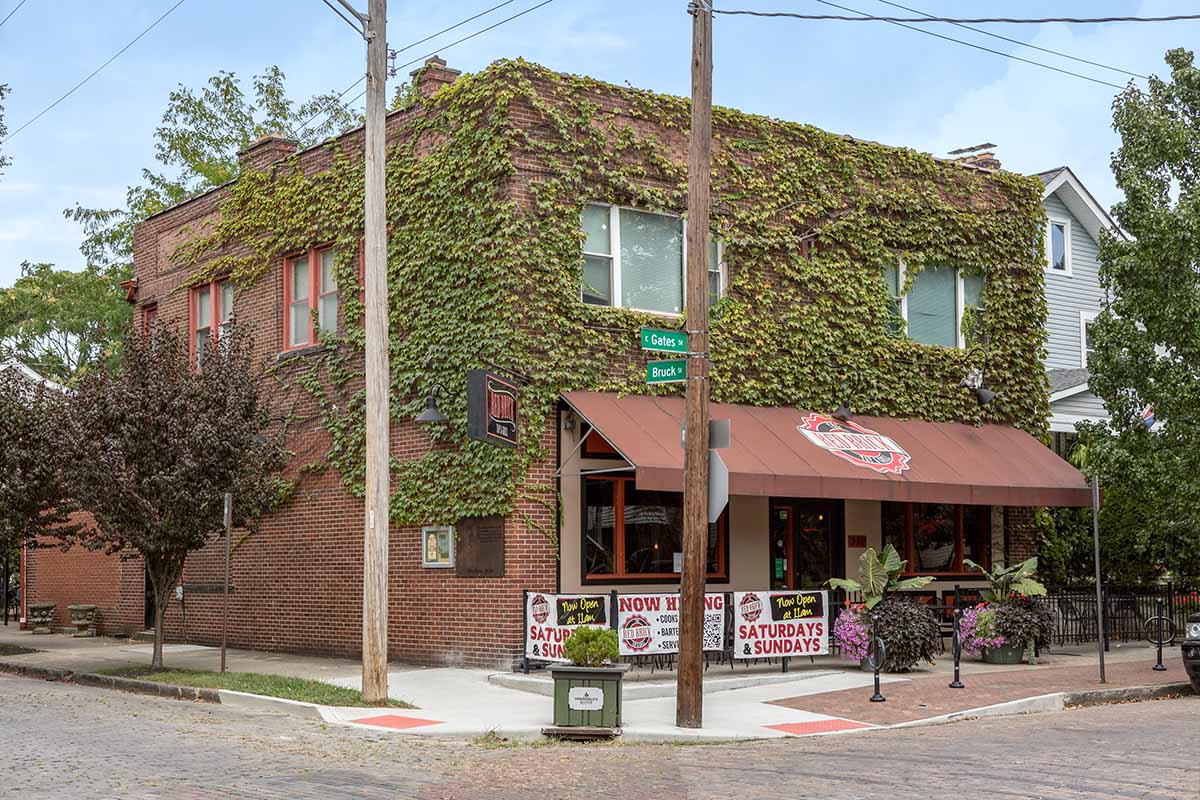
Red and orange brick cottages sit inches apart along brick paved streets, with no building taller than three storeys.
What German Village looks like
is the commercial strip, a run of connected brick storefronts under painted signs, the Book Loft filling one continuous block of former houses. Brick sidewalks line the block. Cars park against the curb, since almost none of the buildings has a driveway.
Off the strip, houses run one and a half to three storeys in red and orange brick, with wrought iron fences marking the property line. They stand only inches apart, fronts set close to the road, small gardens filling what space is left.
Arched brick or stone lintels top many of the windows, and steep gables with dormers break the roofline on some of the cottages. Chimneys sit at the gable ends in red brick matching the walls.
About half the streets keep their original brick paving, the surface running curb to curb and up to the building line on and . Structures and sidewalks are the same orange masonry as the roadway, one material running from building face to curb.
's spire rises 197 feet above the rooflines on Third Street, taller than anything else in a neighborhood where no building runs past three storeys. sits at the center, a shaded green space ringed by more of the same brick houses.
Shot in German Village
They/Them/Us (2021) filmed a scene of its two leads walking along a German Village street. The production's own account does not name the specific street.
They/Them/Us, 2021
The production filmed a walking scene on a brick paved German Village street in August 2020. No specific street is named in the film's own coverage, so no address is given here either.
Over-the-Rhine's Italianate brick rowhouses share German Village's scale, set close together with wrought iron rails and arched brick window heads. Some of its side streets still carry brick paving, the same texture underfoot. Keep wider shots tight, because Over-the-Rhine's blocks generally run three to four storeys, a floor taller than German Village's one and a half to three. Try searching Italianate brick rowhouses now.
Federal Hill's brick rowhouses sit shoulder to shoulder on narrow lots, with marble or stone steps and small wrought iron fences at the sidewalk. Some of its streets keep original Belgian block paving underfoot. The marble steps and attached rowhouse cornices read differently from German Village's freestanding cottages, so a doorway close up gives it away faster than a wide street shot. Try searching Belgian block paving now.
Old Louisville's brick Victorian houses sit close to the sidewalk on a similarly tight grid, some with cast iron fences at the property line. Its lots run larger and its houses taller than German Village's cottages, though the brick tone is close. The bigger porches and taller facades distinguish it in a wide shot, so this works best for tighter frames on a single doorway or fence line. Try searching brick Victorian houses now.