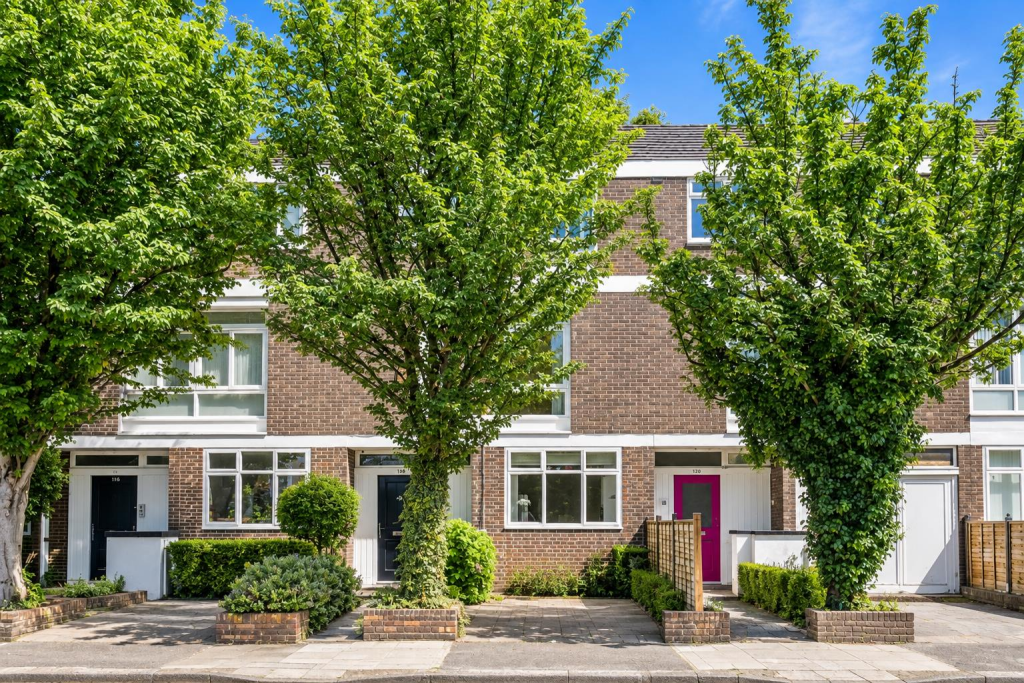
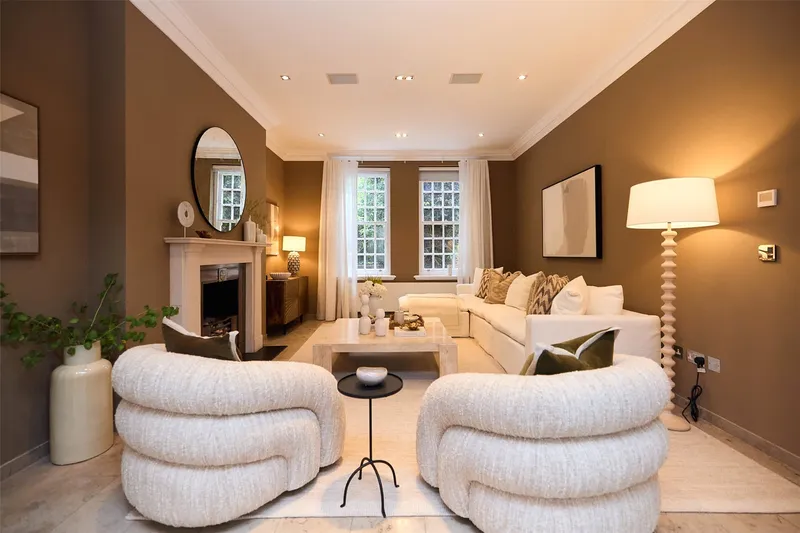
White stucco villas behind hedges line the avenues, with Lord's cricket ground at the eastern edge.
What St John's Wood looks like
White stucco villas line wide, tree lined avenues behind hedges and low garden walls. The same columned porches and balustraded parapets repeat from one gate to the next, and many houses have been divided into flats behind a grand front door and an entryphone panel.
Abbey Road runs past a row of red brick mansion blocks with turrets and balconies before reaching the plain white townhouse at number 3, a recording studio marked only by a small plaque by the door. The zebra crossing outside is a stop for passersby taking their own photograph of it, so the pavement rarely empties.
fills the area's eastern edge with open turf and the low brick perimeter wall of a working sports ground. stands at the roundabout beside it, cream stucco with a columned portico and a small bell tower over the door.
and the streets toward Allitsen Road are smaller in scale, red brick houses and a corner pub rather than a villa behind a gate. The wider traffic runs along Wellington Road, with mature plane trees on both sides.
Shot in St John's Wood
Paddington and About Time both used real corners of St John's Wood on screen. Paddington reads the station's own signage on camera, and About Time's lead walks the length of Abbey Road on foot.
Paddington and About Time
Two real corners of St John's Wood appear as themselves on screen. Paddington uses the Underground station on Wellington Road, and About Time's Tim walks past the recording studio on Abbey Road.
Paddington, 2014
Paddington reads a dogs must be carried sign inside the ticket hall and heads for the escalator, filmed at the station's own Wellington Road entrance. The station's rounded brick and render building dates from the 1930s.
About Time, 2013
Tim walks past Abbey Road Studios dragging a suitcase and a backpack after arriving in London. The plain white townhouse has only a small plaque by the door, no sign announcing what happens inside.
What St John's Wood can double for
Lansdown in Cheltenham, Gloucestershire
Lansdown's white stucco villas sit on wide tree lined avenues with the same columned porches and balustraded parapets as St John's Wood, built in the same few decades. Montpellier next door has the same scale of detached and semi detached villas behind front gardens. Cheltenham's streets curve more than St John's Wood's straight avenues, so a wide establishing shot gives away the difference more than a tight street level frame. Try searching white stucco villas now.
Ballsbridge in Dublin, Ireland
Shrewsbury Road's detached houses sit behind long front gardens on a wide leafy avenue, the same scale as St John's Wood's villa streets. The houses went up in the Edwardian years, a little later than most of St John's Wood. The red brick facades and lantern lit gravel forecourts read differently in close up, so keep the brick out of frame or dress it if the shot needs white stucco. Try searching red brick detached houses now.
Rosedale's big houses on generous lots behind mature trees give a similar sense of scale to St John's Wood's villa streets. The houses themselves mix Victorian and Edwardian styles rather than one repeated white stucco design. Rosedale's streets curve with the ravines rather than running straight, and the mixed styles and driveways show up fast in a wide shot. Try searching big houses mature trees now.