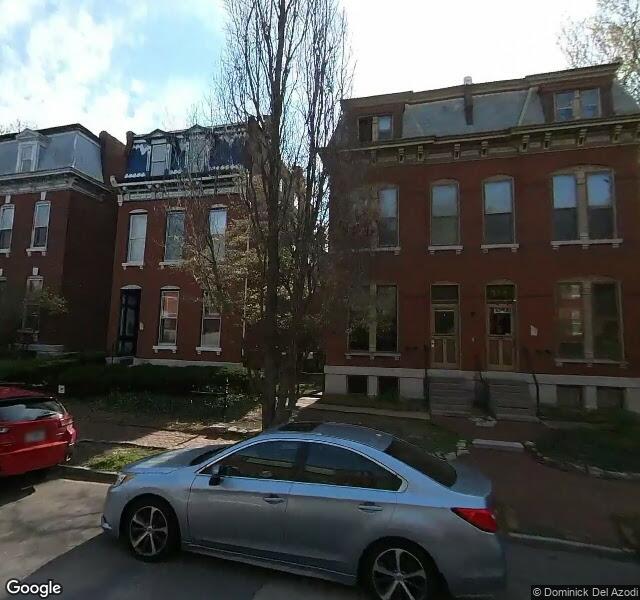
Red brick rowhouses with wrought iron balconies stand near an Italian Renaissance market hall and a brewery at the edge.
What Soulard looks like
Soulard's streets are lined with red brick rowhouses built to the sidewalk line, two storeys for the earliest blocks and taller for the freestanding houses built later. Wrought iron balconies run along the fronts of houses built after 1850, and mansard roofs with dormer windows mark the more ornate ones. Small alley houses sit behind the main rows, reached from lanes that run behind each block. The and the former Brown Shoe Company warehouse are among the manufacturing buildings mixed into the residential blocks, their loading docks and painted sign lettering still visible.
sits at Carroll and 7th Streets, a two storey Italian Renaissance building from 1929. Its H-shaped hall of open brick arcades runs under a tiled roof, with vendor stalls the length of each wing. Round windows line the upper storey of its front block, and produce sits out under the arcade through the day.
South of Lynch Street, the Anheuser-Busch brewery complex takes up several blocks, its brick buildings and towers rising well above the surrounding rowhouses. An arched brick gate with an eagle medallion marks one entrance to the complex. Corner storefronts break up the residential rows at intersections, most still fronted in the same brick as the houses beside them. Parking lines both curbs on the narrow side streets.
Shot in Soulard
For King of the Hill, the production turned Soulard Farmers Market into a 1930s bus terminal. The market's open brick arcades and vendor stalls stood in for the terminal's waiting room and platforms.
King of the Hill, 1993
Soulard Farmers Market
Played the Union Bus Terminal, the 1930s
The market's H-shaped hall of brick arcades and vendor stalls played the Union Bus Terminal in the film. The market still operates on the same corner today.
Over-the-Rhine's red brick blocks carry the same cast iron cornices and arched window heads as Soulard's rowhouses, and Findlay Market gives it a working 19th century market hall of its own. The scale and density of the two neighborhoods line up closely. Over-the-Rhine's buildings run taller and closer together in its commercial core, so a residential side street reads closer to Soulard than the district's main avenues do. Try searching brick market district now.
Fells Point's red brick rowhouses share Soulard's two storey scale and its wrought iron balcony and cornice details, and both neighborhoods sit close to a working waterfront. Fells Point's cobblestone streets look older than Soulard's asphalt blocks. Baltimore's Flemish bond brickwork and dormer shapes differ up close, so a wider shot holds the match better than a single rowhouse doorway does. Try searching cobblestone brick rowhouse street now.
Walker's Point mixes brick houses, churches and small factory buildings much like Soulard does, with surviving pieces of its own former breweries and tanneries. The working class scale is close, though the neighborhood is smaller. Milwaukee's cream city brick runs pale yellow rather than red, so a colour match needs grading or a black and white frame. Try searching brick factory houses now.