Cream city brick tanneries, factories and rowhouse duplexes cross the Menomonee River on movable bridges.
What Walker's Point looks like
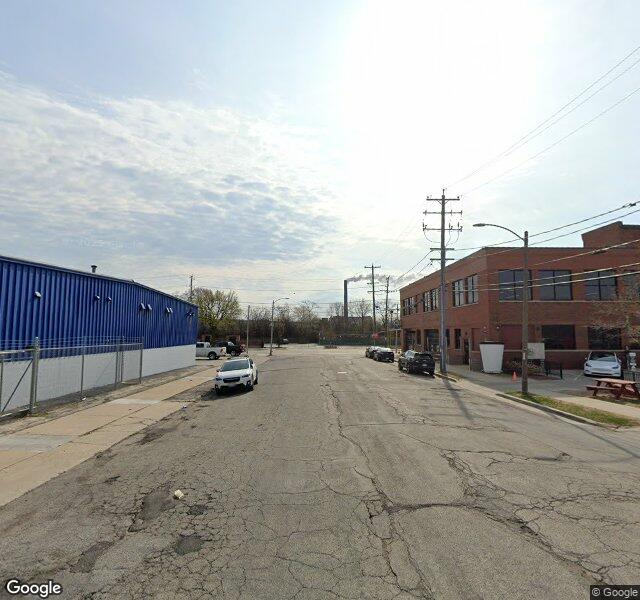
National Avenue runs past low brick storefronts, two and three storeys, with cars angled along the curb and traffic signals on mast arms at the corners. At 2nd Street and National, the 's cream brick front carries a corner turret on a cast iron column and a cupola topped with a weathervane, the date 1887 set into the cornice between them.
South Fifth Street holds the , a factory front in painted concrete and brick topped with a rooftop water tower sculpture on steel legs. Third Street has the darker brick Junior House block, its window bays divided by cast concrete pilasters. The side streets nearby carry frame cottages and low brick duplexes behind chain link fences.
First Street's antique row is lined with narrow two storey shopfronts in painted clapboard and brick, upper windows topped with pressed cornices and turned wood brackets. Florida Street runs past a converted factory building in tan brick with steel frame windows set in a repeating grid, its ground floor now glazed storefronts.
The carries the street grid over the Menomonee River valley on paired bascule and cable stayed spans, passing cream brick tannery buildings at its south end that now hold apartments behind arched top windows. The 's octagonal faces rise over the rooftops to the south. 's cream brick sanctuary on Fourth Street dates from 1849, its steeple visible above the surrounding two storey blocks.
Shot in Walker's Point
The PBS Wisconsin series Wisconsin Life filmed an episode at Zócalo Food Park on Sixth Street in 2024. The crew worked the open lot between the trucks, with the block's low brick buildings behind the picnic tables.
Wisconsin Life, PBS Wisconsin, 2024
The episode follows host Angela Fitzgerald through the lot, moving between the parked trucks and the open seating between them. The segment stays outdoors on the paved lot, never moving inside any building. Street View
Bridgeport's blocks along the South Branch carry the same low brick factory scale as Walker's Point, raised in the same two decades and crossed by the same kind of movable bridge. Racine Avenue holds several plain brick industrial fronts at a matching height and setback. Chicago's river bridges are mostly trunnion bascule spans with a visible concrete counterweight pit at the bank, a detail that reads differently on camera, so keep wide shots off the bridge itself and closer to the factory fronts. Try searching brick factory blocks movable bridge now.
Smallman Street's produce warehouses share the same low brick block and loading dock scale as Walker's Point's converted factories, built across the same two decades. The Strip District runs in a straight five block line rather than around a river bend. There is no river or movable bridge in view along Smallman Street, so a frame that includes either gives the difference away immediately. Try searching brick warehouses loading docks now.
Toledo's district sits against a river the same way, low brick warehouses a few blocks from swing bridges over the Maumee, though the individual buildings run larger and plainer than Walker's Point's mix of factories and storefronts. It works best for a wide establishing frame rather than a street level scene. Toledo's bridges are swing and truss spans rather than bascule, so keep any bridge in frame at a distance where the mechanism is not readable. Try searching swing bridges over the Maumee now.


.jpg)
.jpg)